

What happens when several floating wind turbines share the same anchors? The EU-funded project TAILWIND is exploring the concept, aiming to see how that design compares with other ways of holding turbines in place, in terms of cost and carbon footprint.
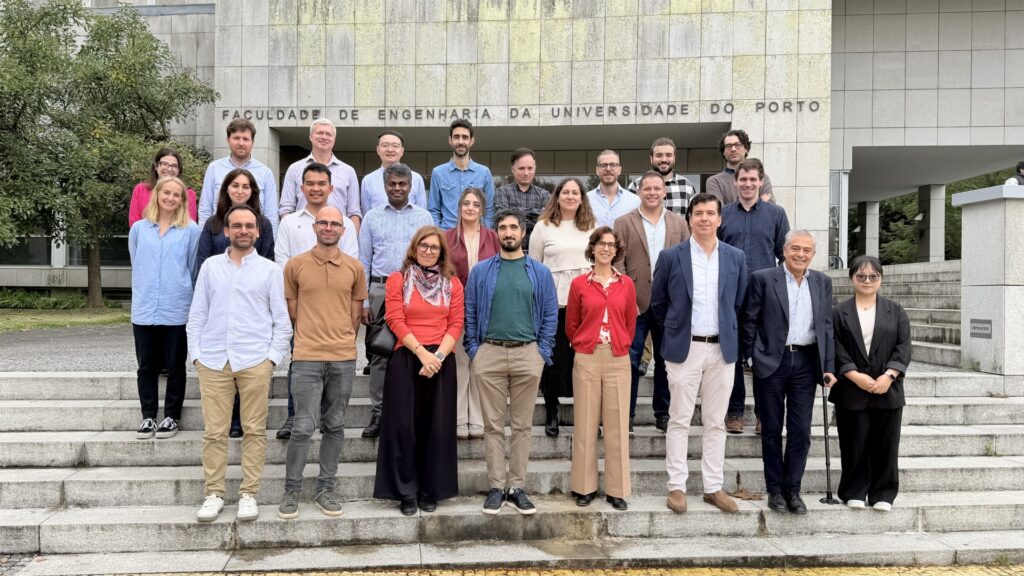
Two advances were among the main updates at TAILWIND’s fourth General Assembly and second review meeting, held recently in Porto and hosted by the University of Porto which joined the project through the Horizon Europe Hop-On Facility in June 2025. Its team has since set out the wave, wind and water depth conditions for the Atlantic case study site off Figueira da Foz and chosen three mooring designs to compare, including one with shared anchors.
Early estimates suggest that sharing anchors could cut mooring costs for a four-turbine layout by more than a third. University of Porto researchers are now using centrifuge test data from the University of Southampton to check a model of how a suction anchor behaves in sandy seabed.
Seabed behaviour is only one part of choosing a design. To put numbers on the comparison, the Technical University of Denmark has extended its WINPACT modelling tool to cover floating offshore wind and estimates what each design would cost and how much carbon it would generate over its lifetime.
The recent open-source release adds modules for mooring lines, anchors and the power cables that move with floating platforms. Each module turns a design into a list of materials, and cost and carbon are both calculated from that same list. The tool is available on Zenodo at this link: https://zenodo.org/records/21964488
Photo credits Cláudia Fonseca – University of Porto
November 10, 2026


