

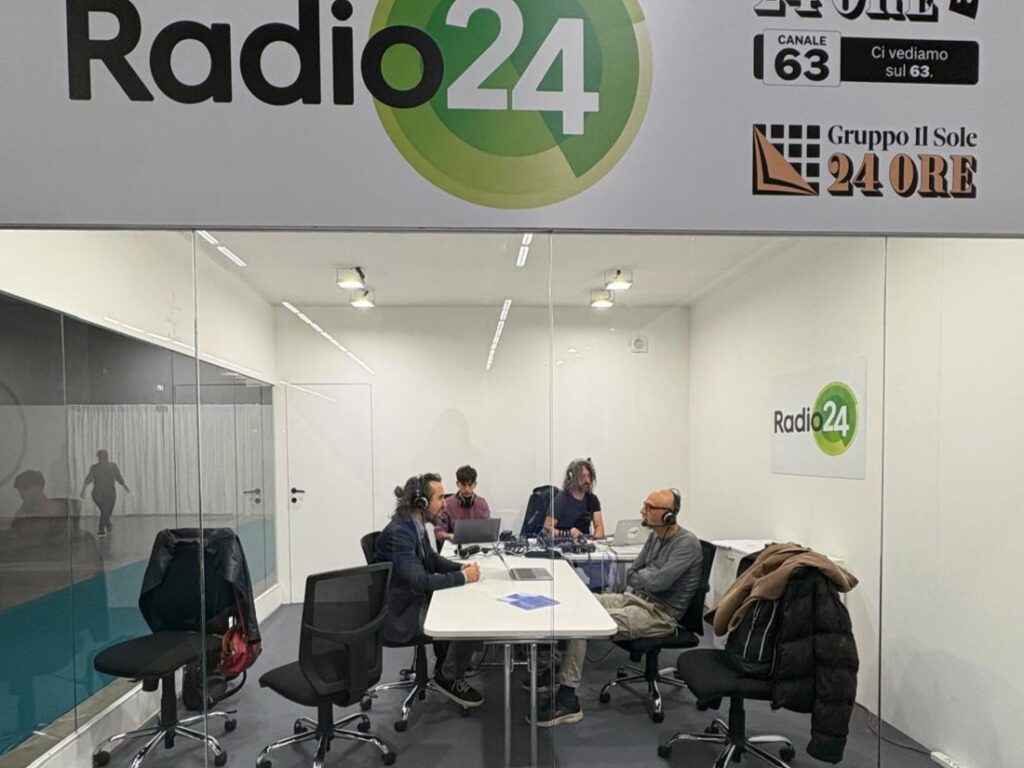
How does a floating wind turbine stay in place through strong winds and rough seas? This practical question opened a recent interview with TAILWIND on Smart City, Radio 24’s programme on technological innovation. For many listeners, a wind turbine on a floating platform is still a new idea. The interview was a chance to explain the engineering behind it to a national audience.
Smart City – Voci e luoghi dell’innovazione airs on Radio 24, an Italian national radio station founded by the business and financial daily Il Sole 24 Ore. Its host Maurizio Melis has covered innovation for radio and podcast audiences for many years, from energy and waste management to the green economy and digital trends. In the episode broadcast on 5 November, he spoke with Federico La Torre, communication officer for TAILWIND at Fondazione ICONS. The interview came about at the expo summit NetZero Milan 2026, where the project presented its work at the Fondazione ICONS stand.
The answer to our initial question starts with the platform itself. Floating platforms allow turbines to operate in waters too deep for conventional fixed-bottom foundations. This opens up areas where winds can be stronger and more consistent. Mooring lines connect each platform to anchors on the seabed and keep it in position as it moves with the wind and waves. Conventional chain-based systems can require long, heavy lines that are costly to install, and sections of chain can drag across the seabed and leave grooves.
One approach discussed in the interview is to use lighter synthetic ropes. TAILWIND researchers at SINTEF in Norway are testing how materials such as nylon and aramid fibres respond to repeated loads. In some mooring designs, a rope’s ability to stretch under load could allow shorter lines. That could reduce the amount of material needed and give developers more choice of installation vessels.
The conversation then turned to anchors. The project is assessing which anchor designs best suit different seabed conditions. It is also studying how platforms could share anchors across a wind farm. If one anchor can handle the loads from several platforms, the farm needs fewer anchors overall, which could further reduce installation costs and environmental impacts.
Listen to the full interview in Italian on Spotify
TAILWIND thanks Maurizio Melis and Radio 24 for bringing floating wind research to Italian listeners. Thanks also go to the NetZero Milan organisers, who introduced their media partner Radio 24 to the projects at the Fondazione ICONS stand.
November 19, 2026


