TAILWIND second newsletter is out now!

The 2nd TAILWIND newsletter is out! Discover project updates, new results in floating offshore wind, and subscribe for the next issue

The TAILWIND consortium is pleased to announce the release of the second edition of its biannual newsletter, dedicated to our project updates on advancing sustainable and cost-efficient station-keeping systems for floating offshore wind.

This new issue showcases several important developments from the past six months. A major highlight is the expansion of the consortium with the University of Porto, strengthening TAILWIND’s presence across key offshore wind hotspots in the Atlantic. In June, we presented an innovative reliability-based mooring design framework at the Wind Energy Science Conference (WESC 2025) in Nantes. In addition, two cornerstone technical reports have been published: Sustainable Anchor Concepts and Design Basis.

Explore the full stories and share the newsletter with your networks: thank you for supporting the TAILWIND project!

The TAILWIND team

Click here to read the full version!

September 24, 2025

University of Porto joins TAILWIND to boost Atlantic floating wind

UPorto joins TAILWIND leading research on the Atlantic coast to fast track floating offshore wind deployment

On 1 July 2025 the University of Porto (UPorto) became a new member of the EU‑funded TAILWIND project. The Portugal’s flagship university brings together its Geotechnical and Hydraulics department to lead Atlantic‑ready station‑keeping systems research.

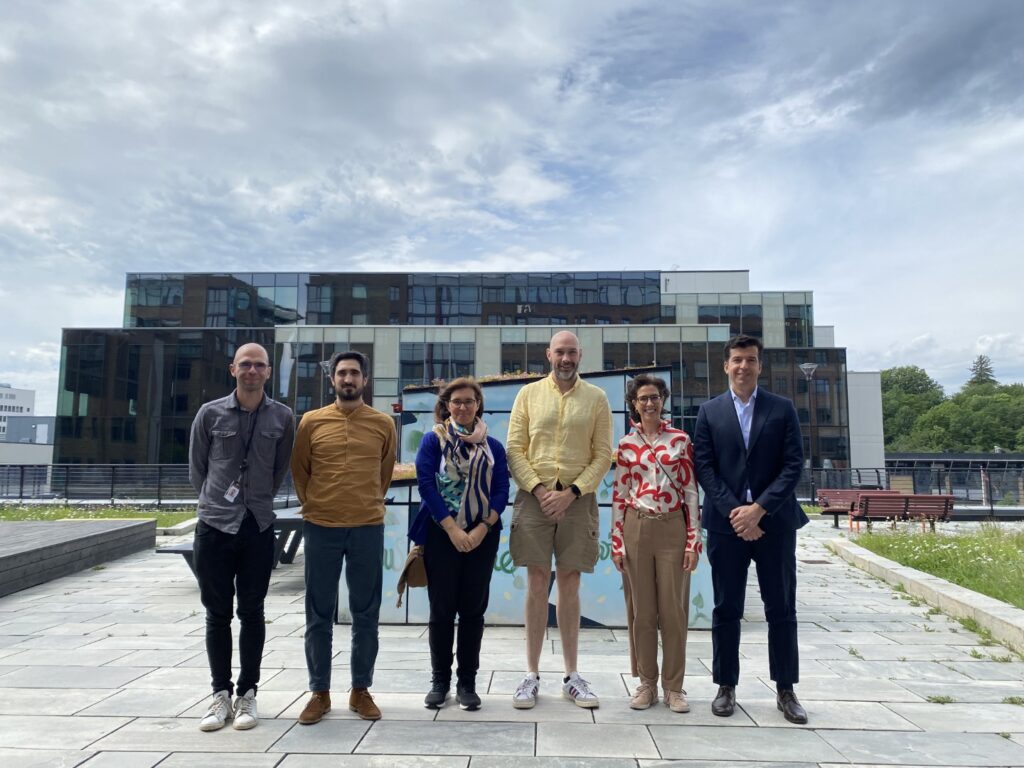
During a dedicated kick‑off meeting hosted by NGI in Oslo, Uporto presented their mission to advance station‑keeping systems for floating wind energy along the Portuguese Atlantic coast. By releasing the findings as open knowledge, the academics aim to speed up commercial roll‑out on this third challenging project site interested by TAILWIND research and innovation activities.

To achieve this result, UPorto will analyse the impact of multidirectional cyclic loading on Atlantic‑coast soils through triaxial tests. The team will also study the hydrodynamic behaviour of moored floating platforms, soil response, scour and potential liquefaction induced by the vibration of mooring line. Insights will feed into advanced numerical models of soil‑anchor systems, to indentify new failure modes, reduce associated risk, enhance design reliability and ultimately optimise ​their​​ design​ and reduce costs.

The work will ultimately deliver resilient, sustainable and high‑performance station‑keeping solutions tailored to the North‑Atlantic coast conditions. By adding Portuguese academic excellence to the consortium, TAILWIND now spans Europe’s three offshore‑wind hotspots, the North Sea, the Mediterranean and the Atlantic Ocean, reinforcing EU leadership in green‑energy innovation.

July 21, 2025

Faster, safer mooring design in the spotlight at WESC 2025

TAILWIND unveils a faster, fail safe mooring design framework at WESC 2025, reducing modelling time and boosting reliability

EU-funded TAILWIND project joined Wind Energy Science Conference 2025, the world’s top wind researchers’ event, in late June. Speaking for the consortium, Azélice Ludot of Denmark’s Technical University (DTU) presented the framework designed for performing reliability-based design optimization (RBDO), with a strong focus on using surrogate modelling to reduce computational time. The optimization targets minimize the cost and environmental footprint of the mooring system while ensuring a robust design.

TAILWIND’s mission is to rethink station-keeping (the mooring lines, anchors and platform layouts that keep turbines on position in deep water) so that floating wind can scale up without scaling its footprint. The team is trialling lighter synthetic ropes paired with taut and semi-taut configurations that minimise seabed contact and make transport easier. However, estimating the probability of mooring line failures, whether due to extreme storms or day-to-day fatigue, is extremely computationally expensive.

The surrogate-based approach used in TAILWIND for performing reliability-based design optimization enables rapid estimates of failure probabilities across evaluated designs: “Floating turbines work in chaotic environments and the cost of mooring failure is enormous,” Ludot explains “Our surrogate models allow us to explore the design space quickly, we can reduce material use and costs while still ensuring that the probability of failure meets industry standards.”

By validating this framework, TAILWIND is pushing the new mooring technology one step closer to commercial pilots, helping floating wind deliver the clean power the world urgently needs. For more detail you can download here the abstract of the presentation held by DTU.

July 15, 2025

New sustainable anchor concepts revealed for floating wind

EU-funded project TAILWIND maps innovation routes to unlock the next generation of floating wind anchors

EU funded project TAILWIND has proposed a sustainable-by-design methodology offering a review of the emerging anchor types and a structured evaluation of the available commercial designs. Five anchor concepts are then identified and investigated as sustainable by design solutions for the two selected offshore sites Utsira Nord (Norway) and Provence Grand Large (France).

Sustainable anchor concepts provides a detailed analysis of installation efficiency, recyclability, local supply‑chain integration and marine‑ecosystem impact for each selected design. To obtain such insight, the project research team exploited data and loading scenarios previously outlined within the Project Design Basis report. The industrial feasibility of five anchors was also benchmarked against technological, economic, environmental and social sustainability expected impacts. All four criteria must be fulfilled, assessing costs and risks for production, transportation and deployment while accounting for value creation in local supply chains and communities.

A first relevant conclusion is that there is no single “best” model for every scenario. Suction and driven pile anchors scored high efficiency level respectively for clay (Norway) and sand (France) seabed; fluke and plate anchors showed better results in terms of geotechnical efficiency; gravity anchors feasibility was only possible on shallow sand sites and it’s not suitable for soft sediments, scoring overall lower than the other anchors tested. Environmental impact and recyclability remain hard to quantify while an installation risk assessment should be included in further studies. As a matter of fact, all the considerations gathered will support the researchers in the ongoing development of TAILWIND project.

In the next phase, TAILWIND experts will test anchors to improve their geotechnical design. “By systematically comparing proven anchors and spotlighting innovation potential in hybrid, grouped and enhanced designs, our intent is to provide a clear and sustainable roadmap to outline ideal anchor solutions that are lighter on materials, faster to install and kinder to the seabed” commented Aligi Foglia from the Norwegian Geotechnical Institute (NGI), TAILWIND Project Coordinator and leader of the anchor technology development team.

Later this year another release will present the mechanical characterisation and durability for synthetic fibre ropes, paving the way for integrated testing of the mooring‑and‑anchor system. Another step forward bridging the gap between research and offshore deployment. Discover more about TAILWIND project progress on the website resource section or by subscribing to the project newsletter.

July 8, 2025

TAILWIND report lays the foundation for new technologies in offshore wind

TAILWIND new deliverable sets the stage for the development of next-generation floating offshore wind (FOW) systems by outlining key scenarios, requirements, and load estimations

Developed with inputs from key partners of the EU financed project TAILWIND, the Project Design Basis is now available on our website. This technical document outlines the main environmental and geotechnic characteristics of two selected offshore sites: Utsira Nord (Norway) and Provence Grand Large (France). It also and explores multiple floater concepts and mooring layouts for floating offshore wind (FOW).

Further detailed environmental characterisation, design assumptions, and load cases are provided in the document guiding the experimental and modelling activities carried out in the project’s technical work packages. The data in this deliverable are currently being used by TAILWIND’s research teams to support the mechanical characterisation of mooring line materials and simulations of anchor-soil interaction. The goal of both new technologies is to reduce the cost and environmental impact of FOW systems while improving reliability and scalability.

Stay connected via our newsletter and social media channels for upcoming releases and updates by TAILWIND partners!


July 3, 2025